It’s April. It’s spring time in Japan! Watch this video on some of the signature flowers and food you can find in Japan around this time of the year.


[ Text in video ]

It’s SPRING time!

I want to show you some spring flowers in Japan, and of course what else, the signature spring food!

From late February to mid March, we have ume. These are plum blossoms. They come in different colors, white, pink, very dark pink, and even yellow. They smell very sweet, and it’s an early sign of spring since they start blossoming before it’s completely warm.

Not only are they pretty, the plums harvested after the flowers are pickled into sour umeboshi… or better yet, made into umeshu, a popular sweet alcoholic drink, also known as plum wine.

These yellow canola flowers are everywhere in spring time. They’re called nanohana. The buds before they bloom are edible, and often served in the spring in some dishes.

You might think I must be picking the pretty flowers, but no. Here I am picking another edible plant called, tsukushi. It’s like the flower part of horsetail plant. This tsukushi is only available for a few weeks of spring time. They are wild and totally edible. Do you eat them in your country?

When you cook them, you have to take off these leafy bits off of the stem. They are hard and wouldn’t be pleasant in your dish.

Here, they are boiled and topped with sesame seeds. You can simply have it soy sauce, but you could also flavor it more with dashi and sugar.

This is a pretty typical table setting in Japan with rice, miso soup, main dish – in this case pork spare ribs – spring cabbage, also delicious around this time, and tsukushi.

Onto another spring food. Can you tell what this is? This is takenoko, literally meaning bamboo child. Well, it’s bamboo shoot. Before turning into the green bamboo that we all know, they look like this in the ground. The earlier they’re picked the better, because they are much softer when they are smaller.

After peeling its skin, you end up with a much smaller portion of takenoko, kind of like an artichoke. You boil it with rice bran in the pot in order to get rid of the unwanted bitterness.

Then you can chop them, make takenoko rice, or many other dishes such as this, or tempura, or simply grill it. The texture is slightly crunchy and it is a real spring delight on your table.

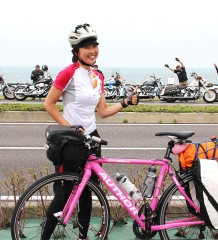
OK. I’ve been saving up the best of spring for the last. Yes, it’s sakura, cherry blossoms. I named my bicycle after this flower too, because this is the one thing that everyone in Japan looks forward to after the cold winter. This is a long cycling road made after a train track in Saga. The sakura tunnel keeps going for miles and miles. You can find many people picnicking and partying under the cherry blossom trees in early April all over the country.

Sakura is edible too. This is called sakura mochi, sweets made with sakura blossom and its leaf.

Spring is not only beautiful, but also really delicious! I hope you enjoyed the spring flowers and flavors of Japan.

Till next time! Matane!

Bookmark and Share

{ 2 comments }

Flowers in Onagawa 女川町にたむけられた花

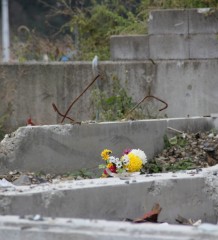
It is March 11, 2012 today. One year ago, the magnitude 9.0 earthquake struck Tohoku, the north eastern Japan, wiping countless beautiful coastal towns with the great tsunami. This huge disaster killed approximately 19,000 people, destroying thousands of homes and businesses that are still far from being recovered.

Just one day before the earthquake struck was the start of my Japan cycling tour. I left my home in Fukuoka Prefecture to head south to Okinawa on my pink bike. I was so far away from the disaster site, but soon found out as I took a break from cycling around 3:30pm that afternoon. The event occurred at 2:45pm.

I was sad, confused, even had guilt for going cycling when so many people were dying as I watched the small TV screen in a little ramen restaurant. I’d done a lot of preparation for my tour, and started cycling with so much excitement like I’d never felt before in my life. Then on the very next day, it happened.

The sadness and helplessness took over me while I was cycling for some time. It took me days to want to share the fun stories with the world like I’d planned. In the middle of this sadness, I just felt lucky to be cycling in the south western Japan. After all, it was in my plan to cycle along the Pacific in the coming months, right where the tsunami struck.

A boat on land in Ishinomaki 石巻の陸に上がった船

There was much confusion in the country and mixed information about the nuclear plant disaster situation up in Fukushima. After six months and having learned more about the situation, I took the safe route to reach my goal on September 12th at Cape Soya of the northern tip of Japan in Hokkaido. After reaching my goal, I headed south and took the ferry boat to Sendai, one of the tsunami struck cities in Tohoku.

Road broken by earthquake and tsunami in Sendai 地震と津波で壊された仙台の道

Even though it had been several months from the event, the coastal towns I reached were much like a post-war zone or possibly even worse. I was overwhelmed, being surrounded by this nothingness and the sheer power of nature that took everything in such short amount of time.


A home in Ishinomaki, wiped by the tsunami 石巻の津波で壊れた家

From Sendai, I cycled to the town of Ishinomaki, one of the badly hit towns in Miyagi Prefecture. I also visited the town of Onagawa, a 30 minute bike ride away from Ishinomaki. Both were fisherman’s towns, but most everything was taken away by the water.

The locals told me so many stories that you would not hear in the news media. I gave a free English tutoring session to a 4th grade girl during the five days of my stay in Ishinomaki. She told me stories that a child should never have to experience. It wasn’t just the tsunami that took away her friends, but also the bullying problems occurring in the temporary school location, where these younger kids were mixed with older middle school students. Teenagers have problems anywhere in the world. I know how awful and hurt it feels, because I’ve been there, being mentally attacked by a thoughtless teenager who ended up giving me an apology letter some months later. I wish I could protect these children, but I can’t be in school with them. The recovery of infrastructure also mean reducing these overlooked, secondary hurtful damages occurring to small school children’s lives.

A building knocked over by tsunami in Onagawa 女川の津波で倒されたビル

It wasn’t all sad being there though. I was surrounded by so many people’s positive energy in Ishinomaki, that the victims of tsunami ended up cheering me up. They’d gone through so much emotional waves in the past six months, but were now back up and working hard to get as close as they could to the norm they used to have. Some young girls must have painted this on this destroyed house. It certainly brought up my mood.

Genki! (We're fine!) Painting by locals in Ishinomaki 元気!石巻

A man my age from Osaka, Chun, had moved to Ishinomaki and had started a bicycle repair shop. It wasn’t much of a business yet, as he’d been volunteering by repairing thousands of bikes before he started charging small fees so he could continue his effort and making it sustainable. He had some horrific stories from the time he entered in Ishinomaki in April. It wasn’t just bike repairing, but so much more he’d done with others to make it as far as they’d gotten when I arrived on my bike, Sakura. Bicycles were the transportation that came in handy right after the tsunami, when little gas and few cars were available in the area. The pedal powered machines were what moved people between places in the days of recovery effort, and they still are.

A bike mechanic from Osaka, now living in Ishinomaki 石巻に住む大阪からやってきた自転車やさん

I helped clean up a property by the place where they let me stay.

Cleaning in Ishinomaki 石巻で掃除

Chun was also an artist. He loved drawing, and this was the sign of his bike shop, Sono Kodomo Cycle. He’d rented a space from this yakitori restaurant owner, whose home/restaurant had been hit by the tsunami, but luckily survived. They’d cleaned it together, and that was where I stayed for five days. Look at this 70 year old yakitori man. He has finally opened up his restaurant again a couple months after I left Ishinomaki. All these people are trying to get themselves back up on their feet to live, and they’ve given me courage and energy to keep moving forward with my life too. It sounds like it should’ve been the opposite, I know, but that is how I felt.

Ishinomaki, Miyagi, Japan 石巻

I saw so many smiles on the survivors. Everyone was helping each other with kindness, and I’d say I was helped more than I helped them during my short stay. I want everyone in the world to know that this recovery effort is still continuing, and will take a long, long time. There are numerous existing problems still, but Japan won’t give up, till we can truly say that we are back up and running again like it used to be. Many, many thanks for all your support and prayers from around the world – we are receiving your love. Peace!

Ishinomaki Bike Shop 石巻の自転車やさん

Bookmark and Share

{ 8 comments }

Chigasaki surf beach 茅ヶ崎 ビーチ

From Okinawa all the way to the center area of Japan, I’d seen many surfers along the coast. This Shonan Beach in Chigasaki is famous as the surf mecca of Japan with the long sandy beach accompanied by a walking / cycling road. I caught so many bicycles with a surfboard holder, parked right by the beach.

Chigasaki Beach, bikes & surfers 茅ヶ崎ビーチ 自転車とサーファー

Dare I say… it’s like the less crazy version of Venice Beach in Los Angeles.

A runner on Chigasaki beach 茅ヶ崎ビーチのランナー

There is a small island by this beach called, Enoshima. You can see it on the right in the above photo.

I cycled over the bridge, and it said, “Welcome to Enoshima.”

Welcome to Enoshima ようこそ江ノ島へ

Enoshima Shrine was what was bringing people to the island. There were also many food vendors leading up to the shrine.

Enoshima Shrine 江島神社

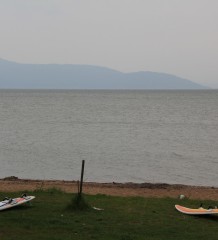
Paddle surfers, wind surfers, internet surfers (namely, me), they were all there.

Paddlesurfers & windsurfers パドルサーファーとウィンドサーファー

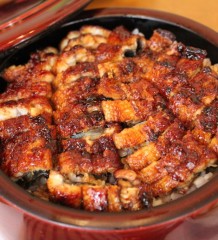
Shirasu don, baby anchovy bowl, was the local lunch of the day. Remember, I’d had the raw one a few days earlier? This one was boiled. The ocean lets us play and gives us good food. How good is she?

Shirasu (baby sardine) bowl しらす丼

This area, south of Tokyo, is also very well known for a number of cultural treasures including the large statue of Buddha at Kotokuin Temple in Kamakura. This is where the government seat was located for the Kamakura Bakufu between the 12th and 14th centuries. Bakufu, also known as shogunate, refers to the military government that existed in Japan. Although the functions and structure differed according to the time in history, the bakufu basically controlled the feudal lords nationwide by assigning them fiefs and requiring loyalty to the shogun in return.

Apparently this Buddha was first built in its own hall, but it was destroyed by natural disasters twice, and they decided to leave it in the open air. I thought it was nice this way with the big sky in the background.

Daibutsu buddha in Kamakura 鎌倉の大仏様

Yes, we respect Buddha in Japan. Yes, we also treasure Hello Kitty. (So do many around the world, it seems.) This is what happens in this country to show our love and respect for the two. The thing about it is that no one gets offended by it. I personally think that Buddha probably finds this funny too. After all, he’s a big man, especially here in Kamakura.

Hello Kitty Buddha of Kamakura...? 鎌倉の大仏キティーちゃん

As I’ve been saying all this time in my blog, cycling and seeing Japan was amazing in more ways than just sightseeing and eating. When I cycled into Tokyo, a stranger in a white van drove along with me, trying to get my attention. He asked me to stop. I was slightly uncomfortable with that since I’d entered the more crowded metropolitan area. But, what happened after was nothing like what I thought it might be.

An older man introduced himself and said he’d cycled Japan when he was in his youth. He gave me words of encouragement with a big smile and enthusiasm, then drove off. I kept cycling and found his van again a few hundred meters later. He was standing by the van with a nicely wrapped small box in his hand. I said hello again. He handed me the box, saying this was very good and wanted me to have it. He drove off again, waving his hand. It was a box of really good rice crackers wrapped in nori (so good they were addictive!) called, Daishimaki. It must have been a gift for someone else, but he ended up giving it to me on the road.

Gift of snacks from a stranger on the road 見知らぬ人からおいしいプレゼント

Just when I thought that a big city like Tokyo could be a hassle to cycle in with my loaded bike, this happened. I realized that it wasn’t by chance that something this nice happened here. I’d encountered people’s kindness way too many times to summarize it just a luck. It was consistently floating around in the air throughout Japan that it was almost harder to miss than encountering. It was the hello, the waving hands, the smiles (and the occasional food offering). All of those brightened my day even when I was out of sorts in my head. Cycling felt as if it was generating something – something invisibly good.

Bookmark and Share

{ 4 comments }

Okonomiyaki お好み焼き

I’ve just learned the story behind National Pancake Day of the UK and some of the Commonwealth countries. (Historically, pancakes were made on Shrove Tuesday to use up fatty and rich foods before Lent started.) People seemed to have enjoyed the day in events like pancake races, running with a frying pan with a pancake inside. All that pancake buzz yesterday got me wanting a pancake too.

As much as I love the pancakes with maple syrup on top, I believe you already know how to make those, and I am on a mission to introduce Japanese cuisine here. So let me show you how to make our savory pancake called, okonomiyaki. I’ve shown you the Hiroshima-style okonomiyaki before from my cycling trip. This one I’m showing you today is the regular version, which is much easier to make. This savory pancake is made with lots of cabbage and whatever meat or seafood you wish to add to it. After all, okonomi means to-your-liking. Mix it all and pan-fry. If you can make a pancake, you can make an okonomiyaki.

[ Recipe for 2 simple okonomiyaki ]

1) In a bowl, mix below into pancake batter consistency
1 cup flower
2 eggs
1/2 cup water (adjust as needed)
1 pinch salt
1/8 teaspoon dashi powder (don’t worry if you don’t have it)

2) Mix veggie into bowl #1
1/2 cabbage (chopped small so it mixes well with the batter)
a few sprigs of green onions (chopped)
1 table spoon benishoga (ginger pickle, colored red – this is not the same as the sweet gari ginger you get beside your sushi)

3) Heat 1 table spoon of oil in a frying pan, and place any of these:
Thinly sliced pork or beef (bacon is fine too) / halved shrimps / sliced squid, etc.

4) Pour #2 on top of #3, and shape it like a big pancake (medium low heat)

5) After a while, flip it (time to test your skills!) to heat both sides just like a pancake until cooked through

6) Put on the topping & Enjoy!
Okonomiyaki sauce*
Mayonnaise
Katsuobushi (shredded skipjack tuna flakes)
Aonori (A type of edible seaweed – I didn’t have this in my cupboard today, but it’s a nice finishing touch)

Okonomiyaki lunch

*If you can’t find a bottled okonomiyaki sauce in the Asian aisle of your store, try this recipe I found:

Ingredients:
1/4 cup ketchup
1 1/2 Tbsp. worcestershire sauce
1/4 tsp. dijon mustard
2 Tbsp. sake (rice wine)
1 tsp. soy sauce

Directions:
Combine all ingredients in a small saucepan and heat until bubbly. Simmer about 30 seconds more, stirring constantly. Remove from heat.

Feeling creative?
If you are inspired to get more creative with your okonomiyaki, you can add things like shredded cheese, chopped mochi, sweet corn, ground nagaimo yam, or tenkasu to your own liking. Enjoy a delicious savory pancake with your own twist!

Bookmark and Share

{ 6 comments }

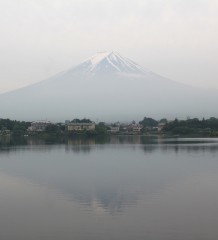
Mt Fuji reflecting on Lake Kawaguchi 河口湖からの逆さ富士

One major reason why I wanted to cycle closer to Mt Fuji was to see Sakasa Fuji, literally meaning, Upside Down Mt Fuji. Mt Fuji has many different nicknames, depending on the way the clouds cover the mountain, or by how the sun shines from behind her. The mirrored reflection of Mt Fuji appears on the surrounding lakes, only when the water is dead flat. This seems easy to come across, but the weather conditions have to be just so.

Waking up by Lake Kawaguchi, I walked across the bridge to catch Mt Fuji in the early morning haze. It was near perfect in its faint appearance, as if it were a huge water color painting in front of me. No, there was no blue sky, nor a clear definition of the mountain, but it felt just right.

Not only was I lucky with Mt Fuji being in a good mood, the wind in the morning decided to wait just until I was done with my morning walk. Twenty minutes later, I could not longer see the mirrored Mt Fuji on the lake.

Mt Fuji reflecting on Lake Kawaguchi 河口湖からの逆さ富士

Moving on from the dreamy images of Mt Fuji, let me show you unreal in another way. This is called yakisoba pan. It is stir-fried noodles in a hotdog bun. Yes, noodles sandwiched in a bread. Confused? Is it totally wrong? It’s actually not as bad as it may seem, plus it was a perfect carb loader for someone about to cycle over the hills.

Yakisoba pan 焼きそばパン

Up, up on the quiet green road I go.

From Lake Yamanaka over the hill 山中湖から山越え

In the clouds you see (or don’t) is Mt Fuji. She was finally hiding from me, but the swans were out and about in Lake Yamanaka.

Swans at Lake Yamanaka 山中湖の白鳥達

Just when I was admiring these pretty swans, I saw something coming from afar in the lake, getting closer and closer to me.

Can it be…?

Oh, it IS.

It’s a GIANT swan SHIP!!

Really, this ain’t no ordinary two-seater duck boat. Isn’t this so… Japan?

This ain't no ordinary two seater duck boat @ Lake Yamanaka あひるボートならぬ白鳥の船 in 山中湖

Being surrounded by the green tunnel feels so good even in the uphill.

Cycling through the green tunnel 緑のトンネルを自転車で

Marking my record speed of 57km per hour on the downhill with a huge adrenaline rush, I took a break by the river with crystal clear water. There I found a rather cute statue of kappa, the Japanese water monster, said to live in rivers and ponds. These mischievous monsters are known to drown children in the river, making them not so cute in its act. I think this folklore may have been a way to warn children to be careful when they swam in the river.

Kappa's Cute Bottom. カッパのおしり。

It was not just the monster that was sitting by the water. Japanese water iris was in full bloom in bright purple and yellow.

Japanese iris 花菖蒲

If you have been to Japan before, but only to the big cities like Tokyo and Osaka, you still have a lot to see in the rest of the country. Majority of Japan is far less crowded and full of nature, just like these rice paddies, with countless mountain hiking trails with see-through rivers to cool you down. Hiking is one of the major activities that many people love in Japan, followed by a long dip in a hot onsen bath to relax the muscles.

Rice Paddies 田んぼ

Cycling between the quiet, peaceful rice fields with birds chirping is a time to cherish.

Foot steps in the rice field 田んぼの足跡

This village looked like it came right out of an old storybook.

A little village in the hills 山の中の集落

Tempura dinner seized the day as I entered Sagamihara City in Kanagawa Prefecture. I was finally in Kanto area (the center region of Japan). Well, that only took 3 short months. Go figure, I can cycle more than just two hours!

Tempura dinner 天ぷら

Bookmark and Share

{ 2 comments }